
On December 11, 2025, PhD candidate Tran Son Hoang, specializing in Pharmaceutical, Medical, and Agricultural Biotechnology, successfully defended his doctoral dissertation entitled “Circulation of pathogens and resistance genes between humans, animals, and the coastal environment in Nha Trang (Viet Nam), as revealed by a combination of phenotypic and omics approaches.”
Tran Son Hoang is enrolled in the co-tutelle doctoral program between the University of Science and Technology of Hanoi (USTH) and the University of Montpellier (France). His doctoral research was jointly supervised by Assoc. Prof. Dr. Nguyen Quang Huy (USTH) and Dr. Yvan Bettarel (Marine Biodiversity, Exploitation and Conservation Center, CNRS, France).
The thesis defense committee comprised six members, including the Chair, Dr. Delphine Destoumieux (Host–Pathogen–Environment Interactions Laboratory, IHPE); Assoc. Prof. Dr. Carles Borrego (University of Girona, Spain); Prof. Dr. Gwenaelle Le Blay (Laboratory of Marine and Environmental Sciences, Brest, France); Prof. Dr. Didier Hoquet (Marie and Louis Pasteur University, France); along with the two supervisors. The defense was also attended by the candidate’s colleagues and friends.
The committee reviewed and validated the candidate’s academic background, research progress, training activities, and scientific outputs throughout the doctoral program. The members highly praised the candidate’s academic performance, research quality, and sustained commitment.
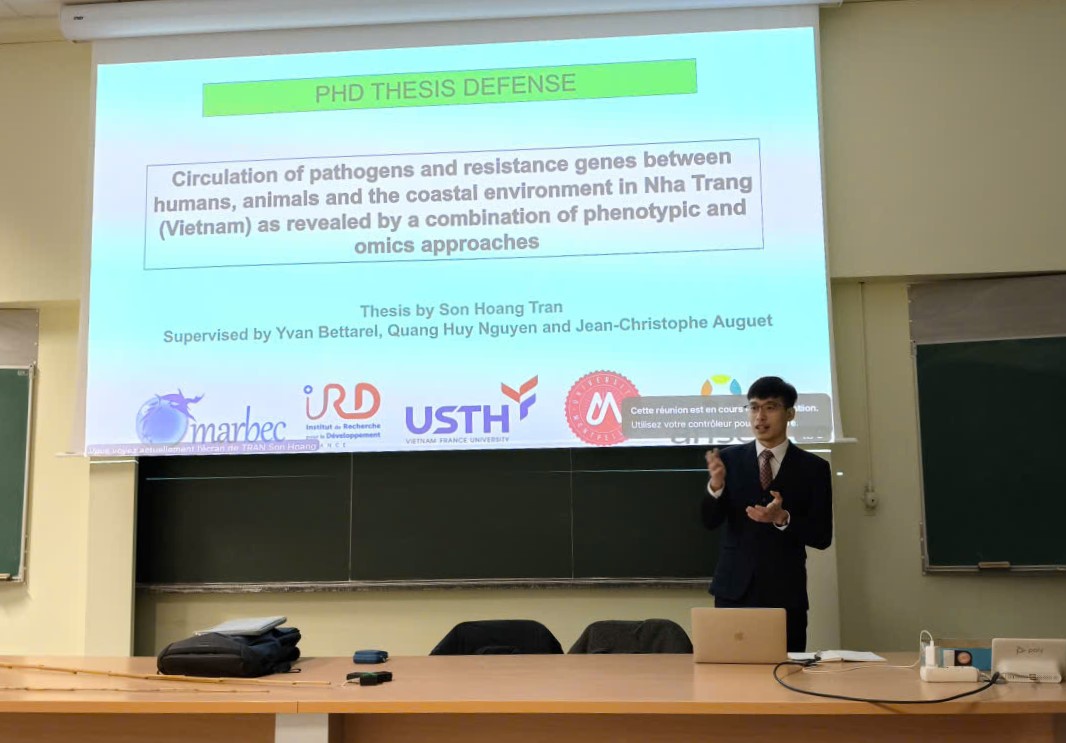
During the defense, the candidate presented the main findings of his dissertation, which address critical knowledge gaps concerning infectious diseases (IDs) and antimicrobial resistance (AMR), highlighting their impacts on human health, animal health, and the environment. The study demonstrates that although research on IDs and AMR has expanded considerably in recent years, most studies have focused on inland ecosystems, with marine environments remaining relatively understudied.
The dissertation contributes significantly to advancing scientific understanding and methodological approaches related to marine pathobiomes and resistomes. Notably, the study utilized the NEMESISdb database, developed by Tran Son Hoang and his research team, to identify potential pathogenic bacteria associated with humans and aquaculture species.
The results reveal that rainfall, riverine inputs, and aquaculture activities (particularly floating cage aquaculture) play a crucial role in shaping the distribution and dissemination of pathogens and antimicrobial resistance genes. Floating cages were identified as “hotspots” for the accumulation of pollution originating from fecal contamination, antibiotic residues, and opportunistic bacteria, thereby increasing selective pressure and facilitating the spread of pathogens and resistance genes among humans, animals, and the surrounding environment. To date, the research outcomes have resulted in two SCIE-indexed publications, with three additional manuscripts currently under preparation and expected to be published in the near future.
Based on the committee’s evaluation, the dissertation reflects the candidate’s rigorous scientific training and strong research capabilities. The work was recognized for its high scientific value and practical relevance. Following closed-session deliberation, the committee unanimously voted (6/6) to approve the doctoral dissertation. The committee congratulated PhD candidate Tran Son Hoang on his successful defense and congratulated the Faculty of Life Sciences on the addition of a new doctoral graduate.
At the conclusion of the defense, PhD candidate Tran Son Hoang expressed his sincere gratitude to the Faculty of Life Sciences, his supervisors, colleagues, friends, and especially his family for their continuous support, encouragement, and favorable conditions that enabled him to successfully complete and defend his doctoral research.